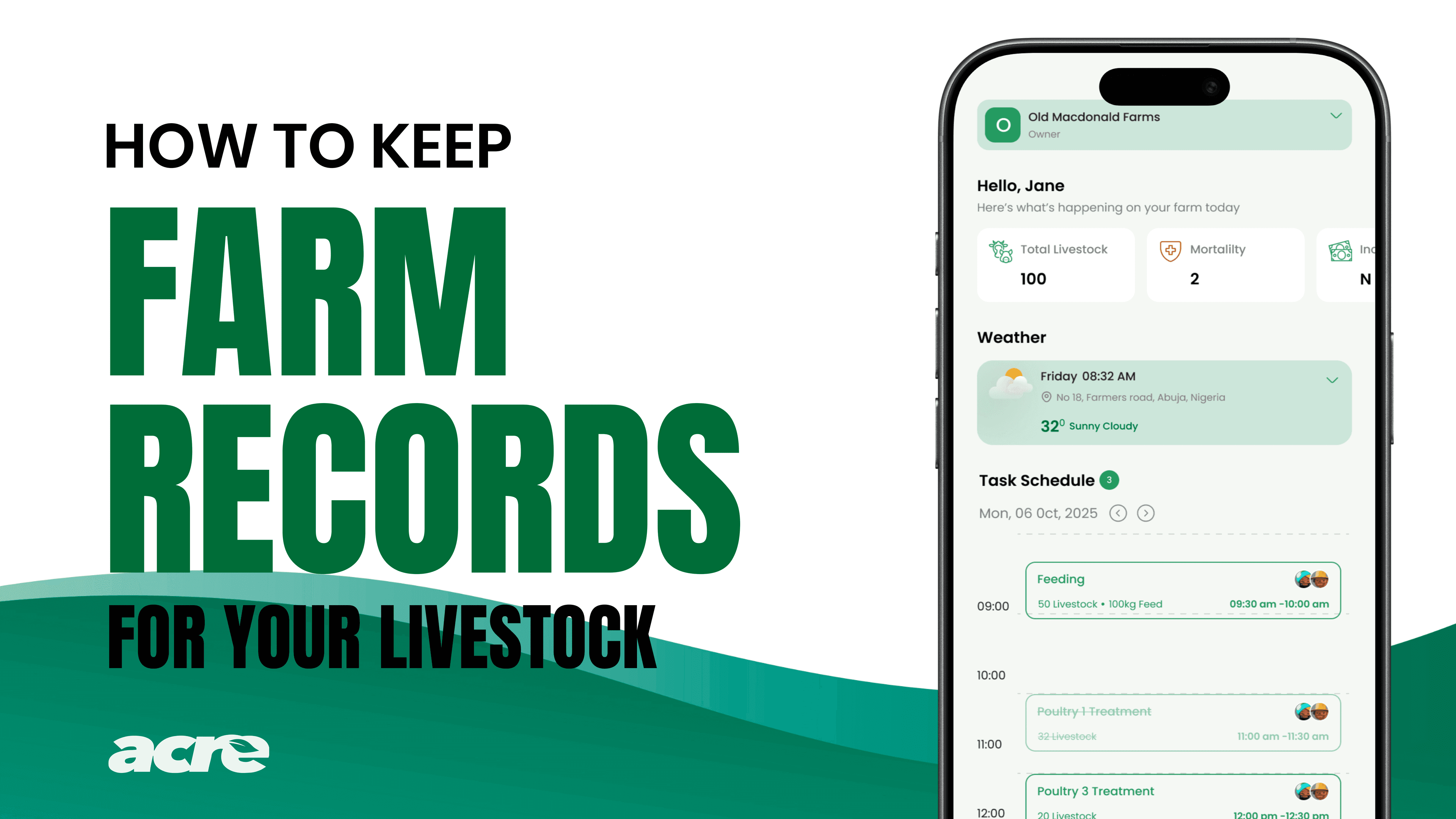
Learn how to keep simple livestock farm records, track expenses, animal
Running a livestock farm involves many moving parts.
You buy animals. You purchase feed. You pay workers. Animals get sick. Some give birth. Others are sold. You vaccinate, treat, transport and maintain your farm.
It can become difficult to remember everything.
And when you don't have accurate records, one important question becomes difficult to answer:
"Is my farm actually making money?"
Good livestock records help you answer that question.
You don't need to be an accountant or own a large commercial farm. Whether you have 20 chickens, 10 goats, 5 pigs or hundreds of animals, you can start with a simple record-keeping system.
Here's how.
What Are Livestock Farm Records?
Livestock farm records are simply information you collect about what happens on your farm.
They help you track three important things:
Your animals. Your money. Your farm activities.
For example, if you rear chickens, your records could show:
How many birds you started with How many died How much feed you purchased How much you spent on medication How many birds you sold How much money you received How much you spent overall
Over time, this information gives you a clearer picture of your farm.
1. Start With Your Animal Records
The first thing to track is your livestock.
You should know what animals you have and what happens to them.
Your animal records can include:
Number of animals Animal type or breed Date purchased Purchase price Births Deaths Animals sold Animals transferred Current number of animals
For example:
Activity Number Chickens at start 100 New chicks added 50 Deaths 5 Chickens sold 30 Current birds 115
This simple information can immediately tell you what is happening to your stock.
Without it, you may think you have 120 birds when you actually have 115.
That difference matters when you're calculating feed requirements, costs and profit.
2. Record Every Farm Expense
This is where many farmers struggle.
They remember major expenses but forget the smaller ones.
You might remember buying 10 bags of feed for ₦500,000.
But what about:
Transport? Medication? Vaccination? Labour? Water? Repairs? Electricity? Housing? Equipment?
These expenses can significantly affect your profit.
A simple expense record should contain:
Date → Item → Quantity → Amount → Reason
For example:
August 3 — 2 bags of feed — ₦100,000 — poultry feeding
Do this every time money leaves the farm.
Don't ignore small expenses.
₦5,000 here and ₦10,000 there may seem insignificant.
But if you spend ₦50,000 on small expenses every month, that's ₦600,000 in a year.
If you're not recording it, you may never realize how much it's costing your farm.
3. Track Your Feed
For most livestock farmers, feed can represent one of the biggest operating expenses.
That's why feed deserves its own record.
Track:
Type of feed Quantity purchased Cost Date purchased Amount used Remaining quantity
For example:
August 1: 10 bags purchased August 10: 6 bags remaining August 20: 3 bags remaining
Now you can begin to understand how quickly your animals consume feed.
This becomes especially useful when planning future purchases and estimating production costs.
4. Keep Animal Health Records
Healthy animals are productive animals.
Your health records should include:
Vaccinations Medication Diseases Treatments Veterinary visits Date of treatment Animal affected Treatment cost
For example:
Animal: Goat #014 Date: August 4 Problem: Loss of appetite Treatment: Veterinary treatment Cost: ₦8,000 Outcome: Recovered
This gives you a history you can refer to later.
It also helps you identify recurring problems.
If several animals experience the same problem repeatedly, your records can help you notice the pattern and seek appropriate professional advice.
5. Record Births and Deaths
Birth and mortality records are extremely important.
If you had 100 animals at the beginning of the year and now have 80, you need to know what happened to the missing 20.
Were they:
Sold? Lost? Transferred? Dead?
For every death, record:
Date Animal type Age, if known Possible cause Treatment history Any relevant observations
You don't need complicated paperwork.
The goal is simply to create a reliable history of your livestock.
6. Record Every Sale
Your sales records tell you how much money your farm generates.
For every sale, record:
Date Animal sold Quantity Selling price Buyer, where appropriate Total revenue
For example:
August 6 5 goats sold ₦80,000 each Total: ₦400,000
After several months, you can look back and understand how much revenue your farm generated.
7. Separate Farm Money From Personal Money
This is one of the most important habits you can develop.
If you use farm money to pay for personal expenses without recording it, your farm's financial picture becomes inaccurate.
You may think:
"The farm made ₦2 million."
But after personal withdrawals and farm expenses, the actual profit could be very different.
Try to clearly separate:
Farm income from Farm expenses from Personal spending
This makes your records much more useful.
8. Review Your Records Every Week
Recording information is only half the job.
You also need to review it.
Set aside 15–30 minutes every week to ask:
How much did I spend? How much did I earn? How many animals do I currently have? Did any animals die? Did I spend more on feed than expected? Were there health problems? What needs attention next week?
These questions turn your records into useful information.
9. Calculate Your Farm Profit
Once you have your income and expenses, you can start calculating your profit.
A simple calculation is:
Profit = Total Farm Income − Total Farm Expenses
For example:
If you generated ₦2,000,000 in sales and spent ₦1,400,000 running the farm:
₦2,000,000 − ₦1,400,000 = ₦600,000
Your estimated profit is ₦600,000.
But remember that the calculation is only as accurate as the records behind it.
If you forgot ₦200,000 in expenses, your reported profit will be misleading.
Good records produce better numbers.
Should You Use a Notebook or a Digital Tool?
A notebook is better than having no records at all.
But as your farm grows, managing everything on paper can become difficult.
You may have multiple notebooks for:
Expenses Sales Animals Health Feed
And eventually, finding information becomes a problem.
Digital tools can make this easier by keeping your farm information organized in one place.
Instead of asking:
"Where did I write that down?"
You can quickly access your records and understand what's happening on your farm.
The Biggest Mistake: Recording Too Late
One of the easiest ways to lose accurate information is to say:
"I'll record it later."
Later becomes tomorrow.
Tomorrow becomes next week.
And eventually, you can't remember the exact amount.
The best rule is simple:
Record it when it happens.
Bought feed? Record it.
Sold an animal? Record it.
Paid a worker? Record it.
Vaccinated your animals? Record it.
An animal died? Record it.
Five minutes today is better than one hour of guessing later.
A Simple Livestock Record-Keeping Checklist
If you're just starting, focus on these seven records:
☑ Animal records ☑ Feed records ☑ Expense records ☑ Sales records ☑ Health records ☑ Birth and death records ☑ Labour records
You don't need to make the process complicated.
Start small and remain consistent.
Your Farm Data Is an Asset
Farmers spend a lot of time thinking about their animals, feed, markets and prices.
But there's another valuable asset sitting on the farm:
Your data.
Your records can tell you which animals perform better, where you're spending too much, when costs increase, how much you're selling and whether your farm is actually profitable.
Without records, you're mostly relying on memory.
With records, you can start making decisions based on what is actually happening on your farm.
Start Recording Today
You don't need hundreds of animals to start keeping records.
You don't need expensive software.
And you don't need to be an accountant.
Start with what you have.
Record what comes into the farm, what goes out, what you spend, what you earn and what happens to your animals.
Over time, those simple records can become one of the most valuable tools for managing your livestock business.
With Acre, you can keep your farm records organized in one place, so you spend less time trying to remember what happened and more time making better decisions for your farm.
Your farm already generates data every day.
The question is: are you keeping it?